AI Tokens on Blockchain: A Plain-English Guide for Business Leaders
The worlds of artificial intelligence and blockchain are converging in a fascinating way. If you’ve heard terms like “AI tokens,” “decentralised compute,” or “blockchain-based AI marketplaces” thrown around in meetings and felt a bit lost, you’re not alone. This guide breaks down what’s actually happening and why it matters for your business.
What Are AI Tokens, Exactly?

Think of AI tokens like arcade tokens from the 1990s. You’d exchange real money for tokens, then use those tokens to play games. AI tokens work similarly: they’re digital units that represent a certain amount of AI computing power or service usage.
When you buy AI tokens, you’re essentially pre-purchasing:
- A number of AI requests (like asking ChatGPT questions)
- A quantity of computing time on AI infrastructure
- Access to specific AI capabilities or models
The key difference from traditional subscription models? These tokens can be traded, transferred, and tracked on a blockchain, creating a transparent record of every transaction.
Why Put AI Tokens on a Blockchain?
You might wonder why AI companies would bother with blockchain technology when they could simply charge credit cards. There are several compelling reasons:
1. Transparent Pricing
Traditional AI pricing can be opaque. You might get a bill at the end of the month without clear visibility into exactly what you’re paying for. Blockchain-based systems record every token transaction publicly, making it easy to audit exactly how many tokens were spent and when.
2. Cross-Provider Flexibility
Imagine if your mobile phone credits worked across all carriers. Some blockchain-based AI token systems aim to create universal tokens that work across multiple AI providers. This gives businesses more flexibility and reduces vendor lock-in.
3. Automated Payments via Smart Contracts
Smart contracts are self-executing agreements written in code. When you use AI tokens on a blockchain, smart contracts can automatically:
- Deduct tokens when you make an API call
- Pay the AI provider instantly
- Apply volume discounts without manual intervention
- Refund unused tokens based on predefined rules
4. Decentralised AI Marketplaces
Blockchain enables peer-to-peer marketplaces where anyone can offer AI services, not just large corporations. Small AI developers can mint tokens representing their services and sell directly to consumers without intermediaries.
How the Token Lifecycle Works
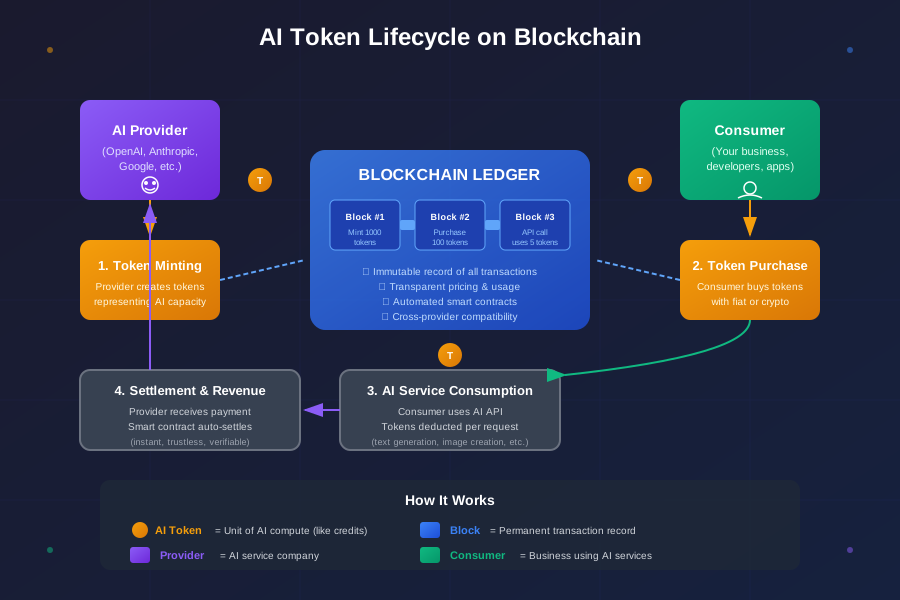
Understanding the journey of an AI token helps clarify how the system operates. The infographic below illustrates the complete lifecycle:
The AI token lifecycle: Providers mint tokens, consumers purchase them, use AI services (with tokens deducted automatically), and providers receive payment through smart contract settlement—all recorded immutably on the blockchain.
Step 1: Token Creation (Minting)
An AI provider creates a fixed supply of tokens. This is called “minting.” Each token might represent, say, 1,000 API calls or one hour of GPU computing time. The minting event is recorded on the blockchain, establishing the token’s authenticity and total supply.
Step 2: Initial Distribution
Tokens are sold to the public through:
- Direct sales: Businesses purchase tokens directly from the provider
- Exchanges: Tokens are listed on cryptocurrency exchanges where anyone can buy them
- Partnerships: Strategic partners receive token allocations
Step 3: Consumer Purchase
Your business buys tokens using either:
- Traditional currency (credit card, bank transfer)
- Cryptocurrency (Bitcoin, Ethereum, stablecoins)
Once purchased, tokens appear in your digital wallet, which is simply a secure account on the blockchain.
Step 4: Service Consumption
When your application calls an AI API, tokens are automatically deducted from your wallet. The blockchain records:
- How many tokens were spent
- Which AI service was used
- The timestamp of the transaction
- The transaction parties (anonymised or identified, depending on the system)
Step 5: Settlement
The AI provider receives the spent tokens, which they can:
- Hold as proof of service delivery
- “Burn” (permanently destroy) to reduce supply
- Sell back to the market to maintain liquidity
Real-World Examples
Several projects are already implementing AI tokens on blockchain:
Fetch.ai (FET)
Fetch.ai has created an ecosystem where autonomous AI agents can transact with each other using FET tokens. Businesses can deploy AI agents that automatically negotiate, pay for, and consume AI services without human intervention.
SingularityNET (AGIX)
SingularityNET operates a decentralised marketplace for AI services. Developers can publish their AI algorithms, and anyone can pay for them using AGIX tokens. This democratises access to AI capabilities that were previously only available to large enterprises.
Ocean Protocol (OCEAN)
While technically focused on data rather than AI directly, Ocean Protocol enables the tokenised exchange of datasets that fuel AI training. OCEAN tokens facilitate secure, privacy-preserving data sharing.
Render Network (RNDR)
Render Network tokenises GPU computing power. Artists and developers can pay RNDR tokens to access distributed GPU rendering, and GPU owners can earn tokens by contributing their hardware to the network.
Bittensor (TAO)
Bittensor has created a decentralised AI network where machine learning models are trained collaboratively. Participants earn TAO tokens by contributing computing resources or valuable AI models to the network.
The Business Case: Why Should You Care?
If you’re a manager or product manager, here’s why this matters for your organisation:
Cost Predictability
Pre-purchasing tokens at a fixed rate protects you from price fluctuations. If AI compute costs rise, your tokens retain their original value.
Budget Management
Tokens create a clear separation between procurement and consumption. Finance teams can purchase tokens in bulk, while development teams spend them as needed without additional approval workflows.
Audit Trail
Every token transaction is permanently recorded. This simplifies compliance, especially in regulated industries where you must demonstrate exactly how AI was used and at what cost.
New Revenue Opportunities
If your organisation develops AI capabilities, you could tokenise them and sell to others. This opens new business models without building traditional payment infrastructure.
Potential Risks and Considerations
It’s worth being clear-eyed about the challenges:
Volatility
If tokens are traded on open markets, their value can fluctuate. A token you bought for £1 might be worth £0.80 or £1.50 a month later. Some systems use “stablecoins” pegged to traditional currencies to mitigate this.
Regulatory Uncertainty
Cryptocurrency regulations vary by jurisdiction and are evolving rapidly. Before investing heavily in AI tokens, consult with legal counsel about the implications in your operating regions.
Technical Complexity
Using blockchain-based systems requires some technical infrastructure: digital wallets, key management, and integration with existing systems. This isn’t insurmountable, but it’s not as simple as adding a credit card to your account.
Early Stage Technology
Many AI token projects are still maturing. Smart contract bugs, network congestion, and platform pivots are real risks with emerging technology.
Getting Started: A Practical Approach
If you’re interested in exploring AI tokens for your organisation, here’s a measured approach:
- Start small: Purchase a modest amount of tokens from an established provider to understand the mechanics
- Evaluate use cases: Identify specific scenarios where token-based AI services could benefit your workflows
- Build internal expertise: Ensure someone on your team understands the basics of digital wallets and blockchain transactions
- Monitor the landscape: The space is evolving rapidly; what’s experimental today may be mainstream tomorrow
The Future Outlook
The intersection of AI and blockchain is still early, but the trajectory is clear. Major technology companies are exploring tokenised AI services, and traditional enterprises are piloting blockchain-based procurement systems.
Within the next few years, we may see:
- Standardised AI token protocols that work across providers
- Enterprise-grade platforms that abstract away blockchain complexity
- Regulatory frameworks that provide clarity for institutional adoption
- Integration with existing ERP systems for seamless corporate use
Conclusion
AI tokens on blockchain represent a fundamental shift in how AI services are bought, sold, and consumed. While the technology is still maturing, the principles are sound: transparent pricing, automated settlement, and flexible cross-provider usage.
For business leaders, the key is to stay informed without getting swept up in hype. The organisations that thoughtfully experiment with these technologies today will be best positioned to capitalise on them as they mature.
Further Reading
- Ethereum.org: What are tokens? - A foundational explainer on blockchain tokens
- World Economic Forum: Blockchain and AI - Policy perspectives on the convergence
- MIT Technology Review: The Merge of AI and Crypto - Technical deep-dives for those wanting more detail
- CoinDesk: AI Tokens Explained - Market-focused coverage of AI token projects
Interested in understanding how emerging technologies like AI tokens could benefit your organisation? Contact Steele O’Brien Consulting to discuss your technology strategy.
Back to Blog